Diversidad

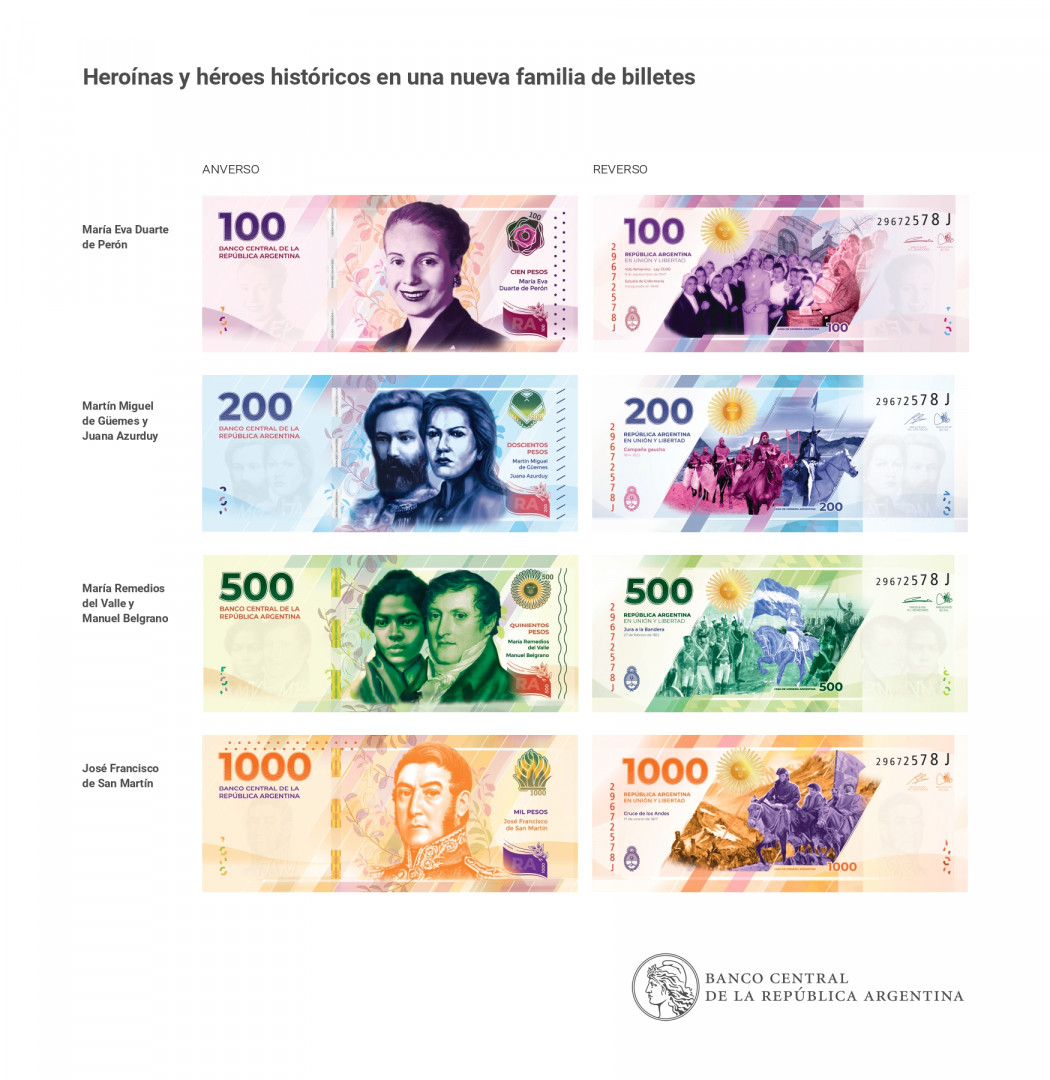
Image: Central Bank of the Argentine Republic
A new family of Argentine peso banknotes, designed by the Banco Central de la República Argentina (BCRA) and Casa de Moneda Argentina (CMA), marks the return of historical character’s illustrations, thus elevating the memory and recognition of Argentinian heroines and heroes who forged our country.
The four denominations (100, 200, 500 and 1000) include the representation of three women and three men, important and decisive figures in the creation of our country, who fought for independence, development, inclusion and the expansion of rights.
The $200 and $500 bring the novelty of including two personalities in the same bill. All the new banknotes, which will coexist with the current ones, will once again be read in a horizontal format from both sides, maintain the colour palette for each denomination and keeping the same size as the ones already in circulation.
New family: María Eva Duarte de Perón ($100); Martín Miguel de Güemes and Juana Azurduy ($200); María Remedios del Valle and Manuel Belgrano ($500) and José de San Martín ($1,000).
María Eva Duarte de Perón (continues in the $100 banknote) Promoter of Law N°13,010 of women’s suffrage (1947) —a norm ahead of its time that established equal political rights between men and women—, Eva is a figure of enormous importance in the fight for the expansion of social and labor rights in our country and an international benchmark. She married Juan Domingo Perón and actively participated in the electoral campaign that led him to the presidency in 1946. Eva was not a classic first lady and exercised an intense political and social influence. She founded the Feminine Peronist Party and had a decisive role in the relationship with the trade unions. Through the Eva Perón Foundation, she channelled an enormous social assistance program until her premature death in 1952. She left an indelible mark as a defender of social and labor rights, and as a fervent promoter of changes in favor of women’s equality and for the inclusion of marginalized people.

Image: Central Bank of the Argentine Republic

Image: Central Bank of the Argentine Republic
Martín Miguel de Güemes and Juana Azurduy (replace the Southern Right Whale – National Natural Monument, in the $200 banknote)
Martín Miguel de Güemes took part in the Reconquest and Defense of Buenos Aires during the English invasions of the Virreinato del Río de la Plata and later played a decisive role in the war of independence. He was governor of Salta and a main player in the Guerra Gaucha, the fierce resistance that safeguarded the northern territories of the country. His forces, “los infernales”, made up of gauchos and countrymen on horseback, were able to stop numerous royalist advances. His successful defence allowed San Martín to organize the liberating army of Los Andes.
Juana Azurduy is one of the great heroines of the Independence. Her performance in the wars against the royalists is recognized with honours by Bolivia and Argentina. She took up arms in a society that prohibited women’s access to the militia, organized and commanded battalions, and managed to mobilize thousands of indigenous and mestizos in favor of the independence cause. Belgrano gave her his sword. She reached the rank of lieutenant colonel and joined the troops of Martín Miguel de Güemes. In 2009, the Argentine government promoted her post mortem with the rank of general.
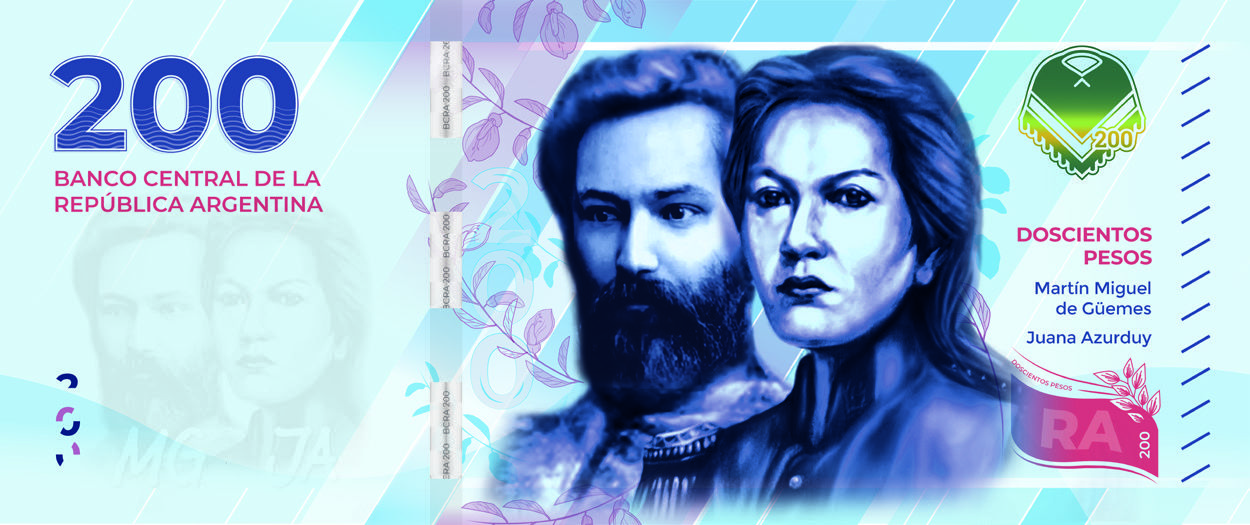
Image: Central Bank of the Argentine Republic

Image: Central Bank of the Argentine Republic
María Remedios del Valle and Manuel Belgrano (replace the “Yaguareté – National Natural Monument” in the $500 banknote)
María Remedios del Valle is a heroine of the War of Independence. As a woman of African descent, she had to face all the prejudices and limitations of her time. She was an auxiliary in the English invasions and, after the Revolución de Mayo, she fought in the Ejército del Norte. For her bravery, Belgrano appointed her with the rank of captain. She was shot, captured by the royalists and publicly whipped. After years of neglect and misery, her work was recognized and she reached the rank of sergeant major. In her honour, Law 26,852 establishes November 8 as the National Day of Afro-Argentines.
Manuel Belgrano, the creator of the Argentine flag, one of the patriots who promoted the Revolución de Mayo and one of the greatest heroes of the war of independence. Educated at the Colegio Real San Carlos de Buenos Aires and later in Salamanca, Valladolid and Madrid, he was a lawyer, journalist, economist, politician, diplomat and military. He participated in the defense of Buenos Aires during the English invasions and, during the war of independence, he led military expeditions in Paraguay, in the Banda Oriental and commanded the Ejército del Norte. He had an outstanding role in the Congreso de Tucumán that declared Independence. He was a fierce defender of the importance of educational, cultural and economic development of the country.

Image: Central Bank of the Argentine Republic
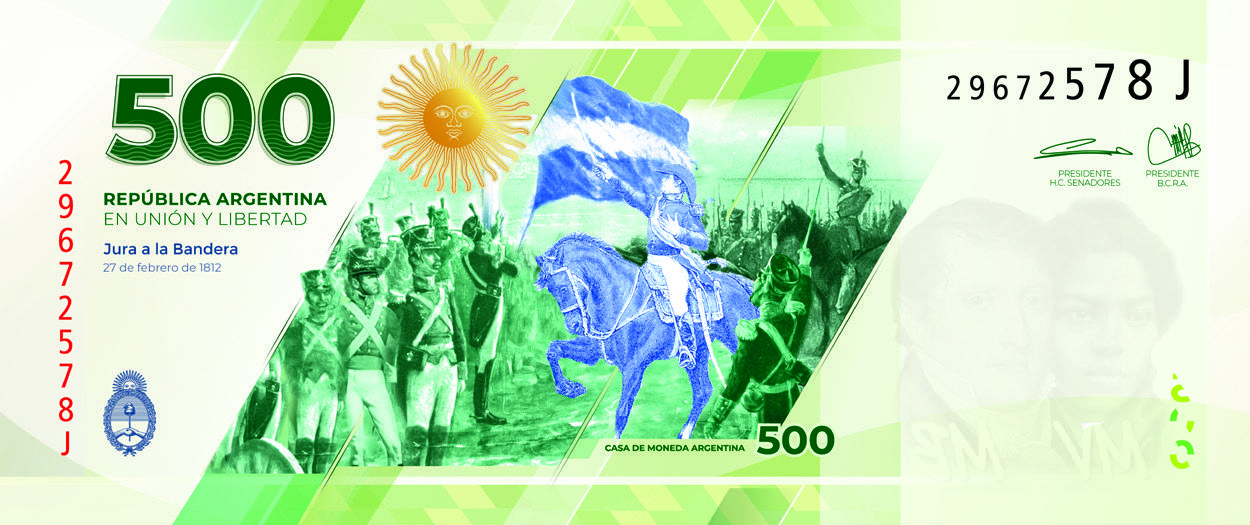
Image: Central Bank of the Argentine Republic
José de San Martín (replaces the “Hornero – Ave Nacional” in the $1000 banknote)
José de San Martín, the Liberator, led the emancipatory forces of Argentina, Chile and Peru and is one of the most emblematic and transcendental figures of the Spanish-American wars of independence. After training as a soldier in Spain, in 1812 he returned to Buenos Aires to put himself at the service of independence. He created the Regimiento de Granaderos a Caballo, commanded the Ejército del Norte and was governor of Cuyo. He devised and executed the continental plan with the objective of eliminating all the royalist centres that maintained the colonial system in America. He accomplished the feat of crossing the Andes Mountains with an army that was decisive in the liberation of Chile and Peru.

Image: Central Bank of the Argentine Republic

Image: Central Bank of the Argentine Republic
Image: Central Bank of the Argentine Republic